Waverley Brownall

Our philosophy is dominated by quality.

  • Home
  • Tube Fittings
    • Ringlok Fittings
    • Duoloc Fittings
    • Stainless Steel Tube
    • Gas Release Flaps
    • Flange Fittings
  • Ball Valves
    • BV 1000 Series Ball Valves
    • 3 Way Ball Valves
    • BV 3000, 6000 Ball Valves
    • PSV8 Ball Valves & Needle Valves
    • Lockable Handle Ball Valves
    • Air Actuated Ball Valves
    • Cast 316 Ball Valves
  • Valves
    • Stainless Steel Needle Valves
    • Check Valves
    • Relief Valves
    • Strainers
    • Manifold Valves
    • Double Block & Bleed Valves
  • Pipe Fittings
    • Hose Components & Unions
    • Plugs, Bushes & Seals
    • High Pressure Precision Pipe Fittings
    • Low Pressure Cast Range of Pipe Fittings
  • Special Metals
    • Titanium
    • 6 Mo Stainless Steel
    • Monel 400
    • Inconel 625
    • Incoloy 825
    • Hastelloy C-276
  • Catalogues
  • About
    • Blog
    • Bespoke Solutions
    • Approvals
    • Case Studies
    • Quality
    • Support
    • Terms & Conditions
  • Contact Us

June 28, 2017 By Waverley Brownall

Corrosion Concerns In Oil And Gas Production

Corrosion Concerns In Oil And Gas Production

Areas of corrosion concern and consideration within the Oil and Gas production industry:

• Pipeline pressure vessel steels for resistance to Hydrogen Induced cracking
• Application of thermal spray coatings (aluminium, zinc and other alloy composites)
• Laboratory testing of metals for resistance to sulphide stress cracking
• Preparation, installation and analysis of corrosion in oilfield operations
• Corrosion control in submerged areas of steel offshore structures (petroleum production)
• Corrosion control of offshore structures with use of protective coatings
• Bacterial growth reporting for oil and gas systems
• Atmospheric and splash concern for offshore zones
• Corrosion control in injection systems – particularly in seawater
• Corrosion control of tubular goods within oil and gas environments
• Evaluation reports concerning pipeline and pressure vessel steels

Visit NACE.org for standards and reports, including specific reports for applications not listed above.

Corrosion by category

Types of corrosion can usually be separated into three separate groups.

corrosion

1) The first group consists of corrosion types that can be seen with ordinary visual examination. These types of corrosion include pack rust, crevice, galvanic and pitting corrosion.

2) The second group includes corrosion types that may require further inspection or testing to define corrosion presence. The second group consists of corrosion such as erosion, exfoliation, fretting and cavitation.

3) The third group will require verification by microscopy, including environmental cracking, fatigue and SCC.

Corrosion resistance and product longevity

Of course, the most common control methods of controlling corrosion includes protective coatings, but even these are at risk of wearing over long periods of time.

For areas of which need longevity above most, such as offshore platforms, something with a stronger resistance is required.

Due to the nature of applications within the Oil and Gas production, one of the best corrosion control methods is within the initial material selection of the fittings, pipelines, valves and instrumentation that is going to be used.

Although no metal is completely resistant to all corrosive natures, NACE advocate that ‘materials selection is critical to preventing many types of failures’.

Looking for corrosion resistant tube, valves or fittings? Speak to our team today
enquiries@waverleybrownall.co.uk

Helpful links:

· Special Metals

· How to solve pipe fitting corrosion

· Corrosion in the Oil and Gas industry

· Corrosion control in Oil and Gas pipelines

· Corrosion in the Oil industry

· Metallurgy and Corrosion Control in Oil and Gas production

· Corrosion basics NACE international

Filed Under: Uncategorized Tagged With: corrosion, corrosion control, corrosion in oil and gas, corrosion prevention, oil and gas industry, special metals, types of corrosion

July 19, 2016 By Waverley Brownall

Corrosion In The Oil And Gas Industry

Corrosion In The Oil And Gas Industry

Corrosion is the chemical reaction and effects caused by environmental factors. It causes damages to metals that weaken their properties and effectiveness. The most common form of corrosion that is instantly recognisable is rust.

Corrosion Prevention Methods: Why Are They Needed?

Many industries are severely effected by corrosion. In fact, the large impact of corrosion within the Oil and Gas industry has reflected in terms of capital, operational expenditures and concerns of Health and Safety regulations.

The Oil and Gas industry is broad – it covers areas of transportation, piping, production and drilling, therefore, the factors of corrosion are a crucial consideration.​

With implications of environmental safety, businesses across the globe must take the potential hazards of corrosion very seriously.

Corrosion: A Matter Of Safety And Expense

Corrosion is one of the most outstanding issues facing the modern Oil and Gas industry.

The potential downfalls of corrosion must be considered at the earliest stages of design, production and installation within any complex environmental conditions.

The Severe Consequences Of Corrosion

With industrial disasters such as the Santa Barbara crude oil spill shows the devastating effect that corrosion can bring to the environment and Oil companies alike. An estimated 105,000 U.S. gallons of crude oil was spilled, coating seven miles of shoreline and tar balls damaging beaches further than 100 miles down the coast.

Another notable case of corrosion damage was the Sinopec Gas pipeline explosion in China. This catastrophe took the lives of 62 people and resulted in a direct economic loss of 750 million yuan ($124.9 million).

It is estimated that corrosion related failures constitute over 25% of failures experienced within the industry of Oil and Gas.

TAKE THE FIRST STEP TO CORROSION PREVENTION
Waverley Brownall offer a range of special metals, also known as high performance alloys that include corrosion-resistant properties.
Valves and fittings manufactured from these high quality alloys benefit a vast range of industries and applications.

Filed Under: Uncategorized Tagged With: corrosion, corrosion control methods, corrosion in oil and gas, corrosion of alloys, corrosion of metals, oil and gas industry, special metals, superalloys

June 3, 2016 By Waverley Brownall

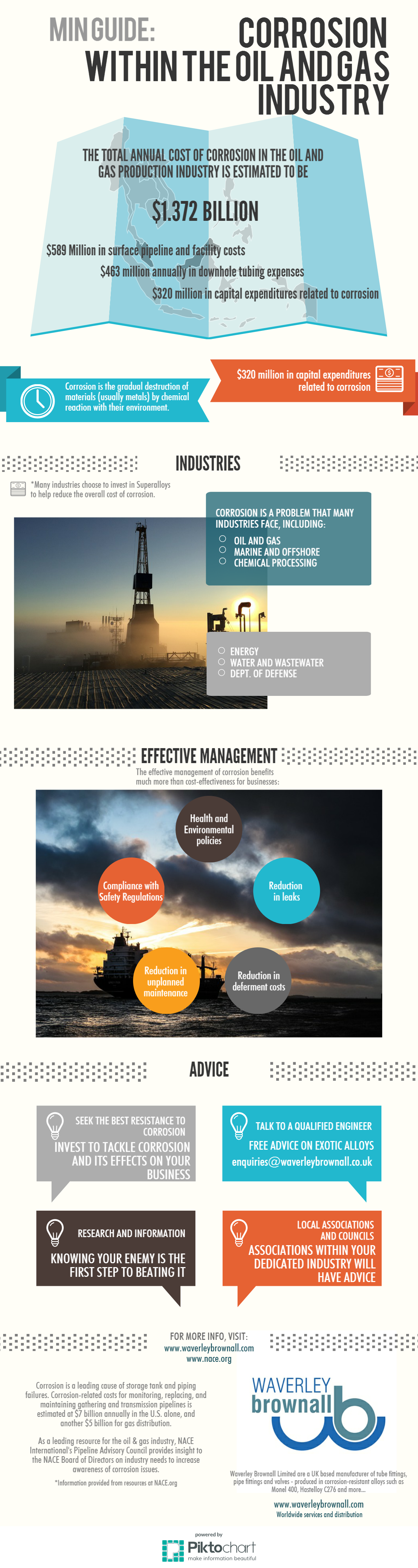
Cost Of Corrosion In The Oil And Gas Production Industry

Cost Of Corrosion In The Oil And Gas Production Industry

“Corrosion control in oil and gas production is reviewed in depth in Treseder and Tuttle, Brondel, et al. and NACE.” Find out more on PetroWiki.org

cost of corrosion in the oil and gas industry

Data sourced from NACE.org Corrosion Central.

Data represented in this Infographic does not represent any endorsement from the NASE council, association or its members with regard to the company Waverely Brownall Limited. Information has been used to further the awareness of corrosion and its difficulties within the Oil and Gas industry.

Filed Under: Uncategorized Tagged With: corrosion in oil and gas, corrosion infographic, Cost Of Corrosion In The Oil And Gas Production Industry, infographic, oil and gas infographic, special metals, superalloys

  • Duoloc Imperial & Metric Charts
  • Ringlok Imperial & Metric Charts

Call us or email us on:
+44(0)1702 600014
enquiries@waverleybrownall.co.uk

Additional Links

  • Approvals
  • Catalogues
  • Case Studies
  • Quality
  • Support

Copyright © 2026 · ·Generate Pro Theme on Genesis Framework · WordPress · Log in

We use cookies to ensure that we give you the best experience on our website. If you continue to use this site we will assume that you are happy with it.